 Izzy Nalley Consulting
Your Change Strategy Isn't the Problem. Your Implementation Might Be.
Why organizational transformation breaks down—and what leaders can do differently.
Organizations rarely initiate major changes without a compelling reason. Whether responding to market pressures, introducing new technology, restructuring operations, or pursuing growth, leadership teams invest considerable time developing strategies intended to move the organization forward.
Yet a well-designed strategy does not guarantee successful transformation.
A company may have a clear vision, a carefully developed implementation timeline, and measurable performance objectives—and still struggle to achieve meaningful adoption across the organization.
The challenge is that organizational change is not simply a strategic or operational process. It is also a human process.
The difference between announcing a change and successfully implementing it often comes down to whether leaders understand the behaviors, perceptions, relationships, and organizational conditions that influence how people respond.
The Gap Between Strategic Intent and Organizational Reality
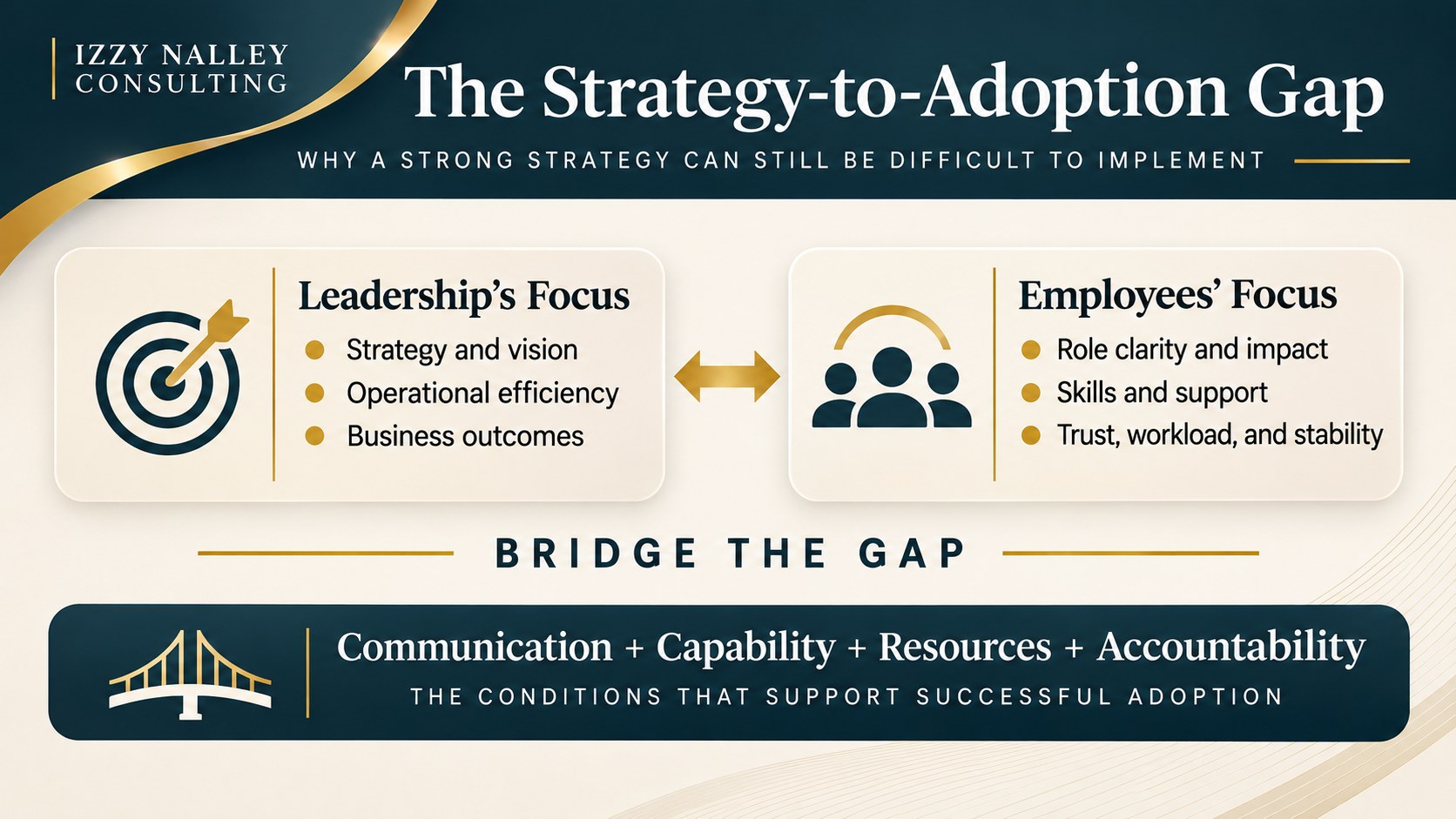
Leadership teams typically evaluate change through the lens of business outcomes.
Will this initiative improve efficiency? Reduce costs? Strengthen competitiveness? Increase revenue? Improve the customer experience?
These are necessary questions.
However, employees experience organizational change through a different set of considerations:
How will this affect my responsibilities?
Will I have the skills and resources to succeed?
What expectations are changing?
Will my experience and input still be valued?
What happens if the new approach doesn't work?
Can I trust the information I'm receiving?
A strategy can make perfect sense from an organizational perspective while creating substantial uncertainty for the people expected to execute it.
When leadership fails to recognize that distinction, implementation challenges may be misinterpreted as employee resistance, poor performance, or a lack of commitment.
In reality, the organization may not have adequately prepared its people to adopt the change.
Resistance to Change Is Information, Not Automatically Opposition
One of the most common mistakes leaders make is treating resistance as a problem that must be overcome rather than a response that deserves investigation.
Not all resistance is the same.
An employee questioning a new process may be identifying a legitimate operational risk. A manager hesitant to adopt a new reporting structure may be concerned about unclear authority. A team struggling with a technology rollout may lack the training or capacity needed to integrate it into existing workflows.
These responses are not necessarily evidence that employees oppose progress.
They may reveal weaknesses in the implementation strategy.
Research on organizational change has long examined how employee attitudes, perceptions, and readiness influence change outcomes. The work of scholars such as Armenakis, Harris, and Mossholder emphasizes the importance of creating readiness for change rather than assuming employees will automatically support an initiative once it is announced.
For leaders, this requires a shift in perspective.
Instead of asking:
"Why are our employees resisting this change?"
Ask:
"What is preventing our employees from successfully adopting this change?"
The first question focuses primarily on employee behavior.
The second creates an opportunity to examine leadership communication, organizational systems, available resources, and the change itself.
That distinction matters.
Five Reasons Organizational Change Breaks Down During Implementation
1. Leaders communicate the decision but not the reasoning.
Employees are often told what is changing without receiving sufficient context about why the change is necessary.
Leadership may have spent months evaluating market conditions, operational challenges, and strategic alternatives. Employees may receive the final decision in a single meeting or announcement.
That information gap creates opportunities for confusion, speculation, and distrust.
What leaders can do differently:
Communicate the business rationale, the intended outcomes, and the implications for employees. Be transparent about what has been decided, what remains uncertain, and where employees can provide meaningful input.
Effective communication should continue throughout implementation rather than ending with the initial announcement.
2. The organization underestimates the behavioral changes required.
A new system, organizational structure, or operating process may look straightforward on paper.
But implementation frequently requires employees to change established habits, learn new skills, collaborate differently, or redefine how they measure success.
These behavioral adjustments require more than instructions.
They require time, reinforcement, practice, and support.
What leaders can do differently:
Identify the specific behaviors that must change for the initiative to succeed.
Rather than measuring only whether training was completed or a system was launched, evaluate whether people are consistently using the new processes and practices.
3. Managers are expected to lead change without adequate preparation.
Middle managers occupy a critical position during organizational transformation.
They must interpret strategic decisions, communicate expectations, address employee concerns, maintain performance, and adapt their own responsibilities.
Yet they may receive little more preparation than the employees they supervise.
This creates a difficult situation: managers are expected to build confidence in a change they may not fully understand themselves.
What leaders can do differently:
Prepare managers before broad implementation.
Equip them with clear communication guidance, opportunities to ask questions, practical tools for managing transitions, and defined channels for escalating issues.
Managers should be active participants in implementation—not merely messengers delivering executive decisions.
4. Competing priorities undermine execution.
Organizations frequently launch major initiatives without adequately accounting for existing workloads.
Employees are expected to maintain current performance while learning new systems, attending training, participating in implementation meetings, and adjusting established processes.
When leadership does not reconsider priorities or resource allocation, change becomes an additional burden rather than an integrated organizational objective.
What leaders can do differently:
Evaluate the capacity required for implementation.
Determine which responsibilities can be adjusted, which activities should be temporarily deprioritized, and where additional resources may be necessary.
An initiative cannot become a genuine organizational priority if everything else remains equally urgent.
5. Success is measured by completion rather than adoption.
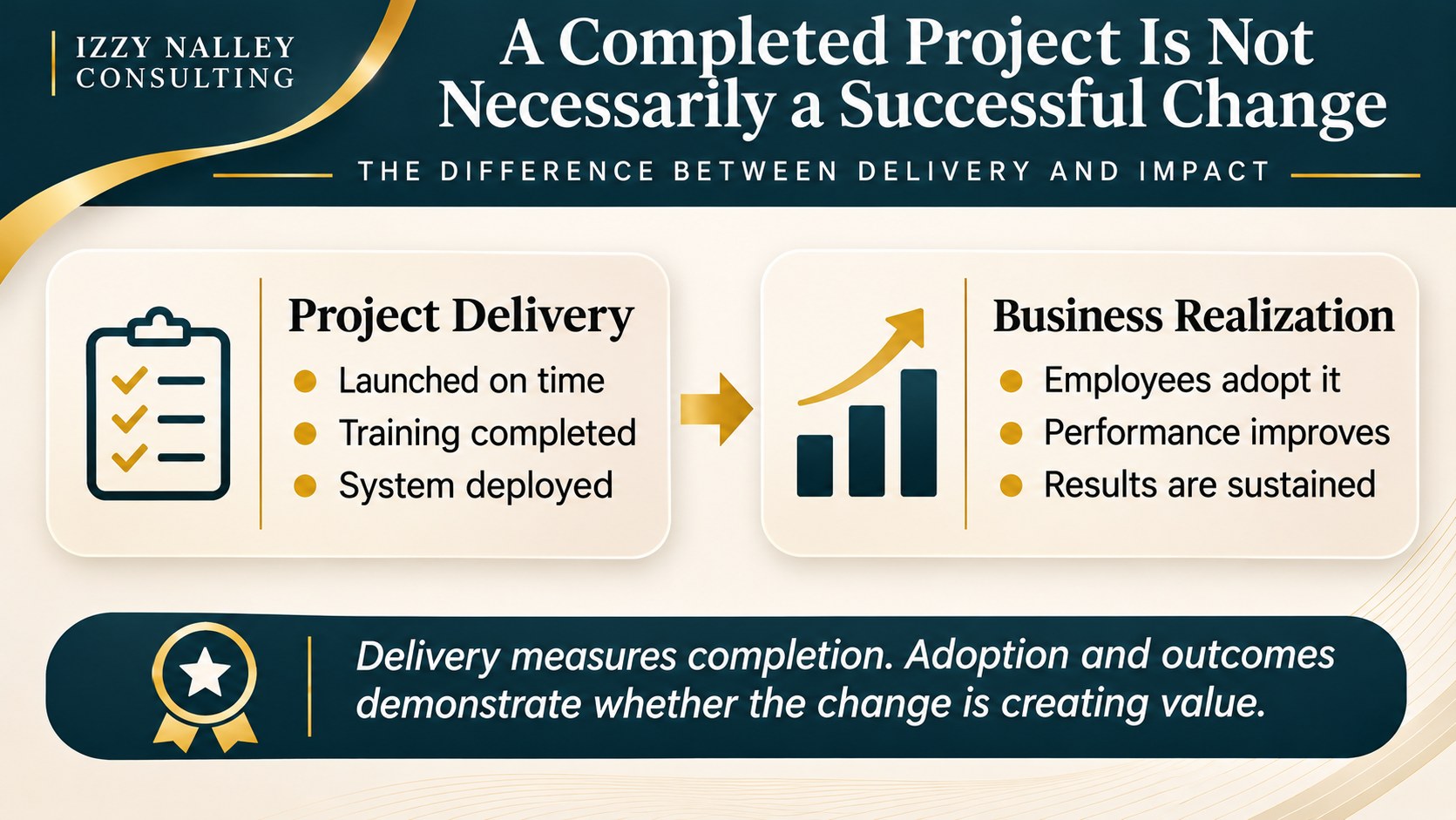
A project can be delivered on schedule and within budget without achieving its intended business outcomes.
A new technology platform may launch successfully while employees continue using previous workflows.
A restructuring may be formally completed while decision-making remains fragmented.
A leadership development initiative may receive excellent participant feedback without producing sustained changes in workplace behavior.
Implementation milestones and organizational outcomes are not interchangeable.
What leaders can do differently:
Define success at multiple levels:
Delivery: Was the initiative implemented as planned?
Adoption: Are employees consistently using the intended processes or behaviors?
Effectiveness: Is the change improving the performance indicators it was designed to influence?
Sustainability: Are the improvements maintained over time?
This broader evaluation helps organizations distinguish between completing a project and realizing its intended value.
The Behavioral Science Behind Successful Change
Human behavior is shaped by more than conscious intention.
Established habits, environmental cues, social expectations, perceived consequences, and available resources all influence whether individuals adopt new behaviors.
This is particularly relevant in organizational settings, where employees operate within systems of formal responsibilities, informal norms, performance incentives, and established relationships.
Behavioral science provides a useful framework for understanding why simply communicating a new expectation is often insufficient.
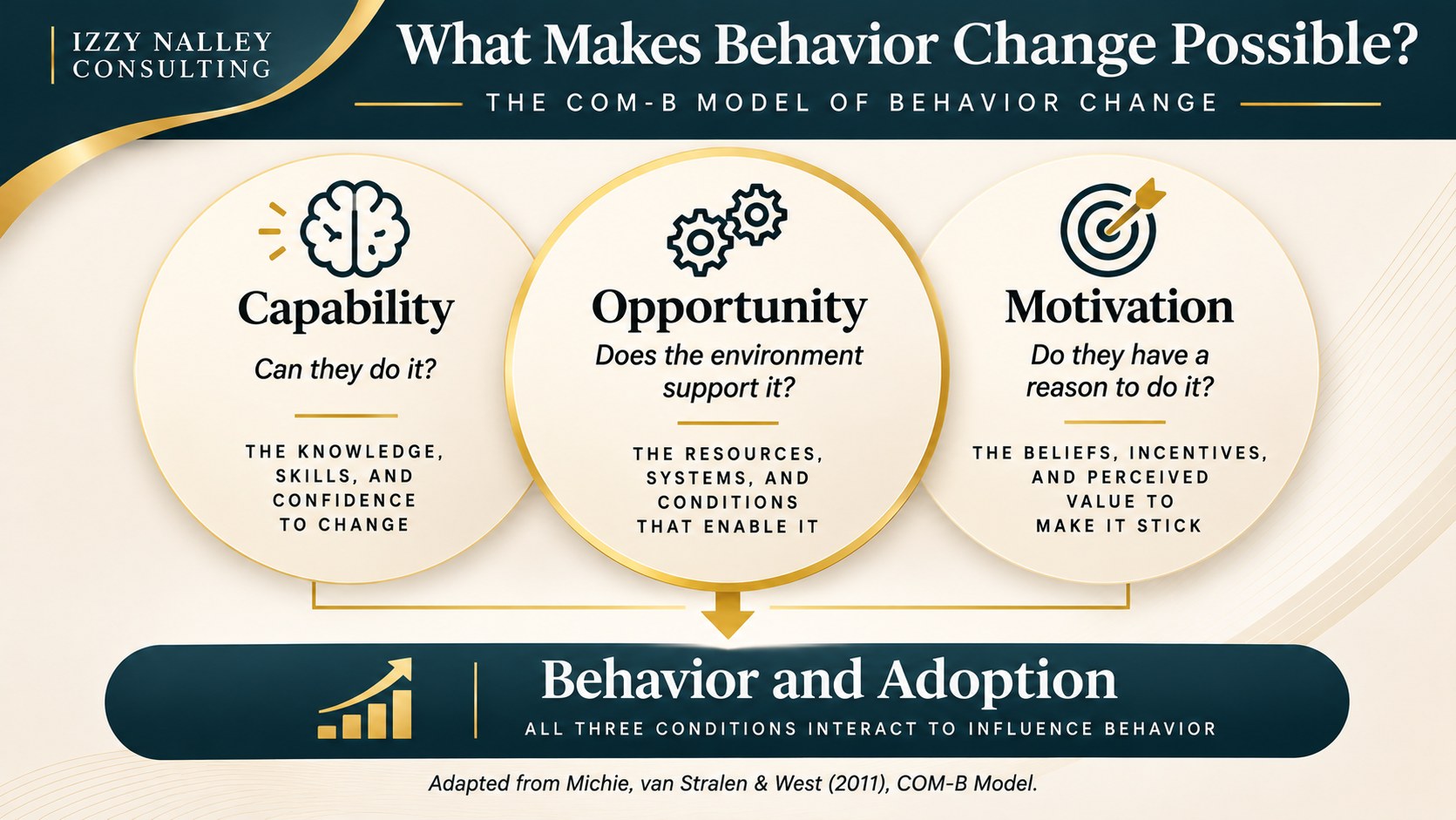
The COM-B model, developed by Susan Michie and colleagues, identifies three broad conditions that influence behavior:
Capability: Does the individual have the knowledge and skills required?
Opportunity: Does the environment provide the resources, systems, and conditions necessary?
Motivation: Does the individual have sufficient reasons and willingness to engage in the behavior?
Consider an organization implementing a new customer relationship management system.
Employees may understand why the new system is important and genuinely support the initiative.
But if the software is difficult to use, existing workloads remain unchanged, or managers continue requesting reports from the previous system, adoption may suffer.
The issue may not be motivation.
It may be capability or opportunity.
This is why effective change leadership requires more than persuasive communication. It requires examining the conditions that enable people to behave differently.
A Practical Framework: Five Questions Leaders Should Ask Before Implementing Change
Before launching a significant organizational initiative, leadership teams can strengthen their implementation approach by answering five questions.
1. What must people actually do differently?
Identify the specific behaviors, decisions, workflows, and responsibilities that need to change.
2. What might prevent those behaviors from occurring?
Examine skill gaps, competing priorities, unclear authority, resource constraints, and concerns about the proposed change.
3. Who will be responsible for supporting adoption?
Clarify the roles of executive sponsors, managers, project leaders, and other stakeholders.
4. How will employees receive information, training, and feedback opportunities?
Establish ongoing communication and practical mechanisms for addressing emerging implementation challenges.
5. How will we know whether the change is working?
Define meaningful indicators of adoption and business impact—not simply project completion.
These questions will not eliminate every implementation challenge.
They can, however, help leadership teams identify foreseeable obstacles before those obstacles become expensive problems.
The Role of Leadership in Organizational Transformation
Successful change requires more than executive sponsorship or a compelling strategic presentation.
Leaders must create alignment between organizational objectives and the conditions employees need to execute them.
That involves communicating clearly, inviting useful feedback, addressing barriers, clarifying accountability, and adjusting implementation plans when evidence indicates that something is not working.
It also requires recognizing that organizational transformation is rarely a perfectly linear process.
Teams learn as they implement. Assumptions are tested. Unexpected constraints emerge. Some decisions need to be revisited.
Effective change leadership is not demonstrated by rigidly defending the original plan.
It is demonstrated by maintaining strategic direction while responding intelligently to operational realities.
From Strategy to Sustainable Execution
Organizations do not achieve transformation simply because leadership makes a decision.
Transformation occurs when new expectations become consistently practiced behaviors, supported by appropriate systems, leadership practices, and organizational conditions.
A strong strategy establishes direction.
A strong implementation approach makes that direction actionable.
And effective leadership connects the two.
Before launching your next major initiative, consider this question:
Have we developed a strategy for what the organization needs to achieve—or have we also developed a strategy for how our people will successfully achieve it?
The answer may determine whether your next change initiative becomes a completed project or a meaningful organizational improvement.
About the Author
Izzy Nalley, MBA, is a business consultant, leadership educator, and strategic facilitator specializing in organizational change, leadership development, team effectiveness, and strategic execution.
Through Izzy Nalley Consulting, she works with organizations to strengthen leadership effectiveness, navigate organizational transitions, align stakeholders, and translate strategic priorities into actionable plans.
For corporate training, executive education, or strategic facilitation inquiries, visit izzynalleyconsulting.com.
Selected References
Armenakis, A. A., Harris, S. G., & Mossholder, K. W. (1993). Creating readiness for organizational change. Human Relations, 46(6), 681–703.
Michie, S., van Stralen, M. M., & West, R. (2011). The behaviour change wheel: A new method for characterising and designing behaviour change interventions. Implementation Science, 6, Article 42.
Kotter, J. P. (1995). Leading change: Why transformation efforts fail. Harvard Business Review, 73(2), 59–67.
